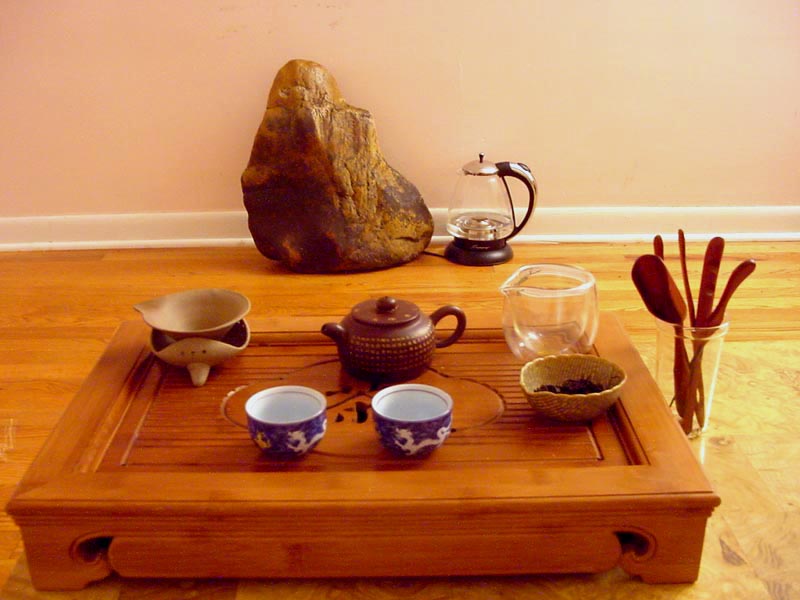
Gōngfū Chá (功夫茶) — Brewing Guide
Gōngfū Chá (功夫茶) — Brewing Guide
Gōngfū chá (功夫茶, gōngfū chá, "tea with skill") is the Chinese method of brewing tea using a small vessel, high leaf-to-water ratio (1 g per 10–15 ml for oolongs), and multiple short sequential steeps through the same leaf. The word gōngfū (功夫) means applied effort or skill, not only martial arts. It originated in the Cháozhōu-Shàntóu region (潮汕地区, Cháoshàn dìqū) of eastern Guǎngdōng, historically developing around Fènghuáng dān cōng (凤凰单丛, fènghuáng dān cóng) and Wǔyí yánchá (武夷岩茶, wǔyí yánchá, cliff oolongs). It became the standard method for oolongs and pǔ'ěr before spreading to other tea types. The essential insight: successive short steeps reveal how a tea changes across infusions, exposing qualities that a single long steep cannot.
As described in Cháozhōu Chá Jīng (潮州茶经, Cháozhōu Tea Classic, late Qīng): "Gōngfū tea is not about the tea alone but about the vessel, the water, the fire, and the time — remove any one and the method collapses."
Equipment
| Item | Function | Notes |
|---|---|---|
| Gàiwǎn or yíxīng teapot | Brewing vessel | Gàiwǎn for evaluation; yíxīng for dedicated daily use. In the classic Cháozhōu tradition, special hand-pulled red clay teapots (潮州手拉壶, cháozhōu shǒu lā hú) are used, made on a potter's wheel rather than by moulding. |
| Pitcher (公道杯, gōngdào bēi) | Stops extraction; equalises pours | Pour completely from vessel into pitcher after each steep |
| Tasting cups (品茗杯, pǐnmíng bēi) | Drinking; 30–50 ml each | Thin-walled porcelain for precision. In Cháozhōu, tiny cups of just 15–20 ml are traditional, known as "three cups" (三杯, sān bēi), one for each participant. |
| Variable-temperature kettle | Precise temperature control | Different teas require different temperatures |
| Tea tray (茶盘, chápán) | Catches rinse water and spills | Keeps the session clean. For the classic Cháozhōu style, small clay trays with a fish pattern (鱼池, yú chí) are used. |
Water
The quality of water heavily influences the result. The classical Chinese treatise Chá Jīng (茶经, "Tea Canon") by Lù Yǔ (陆羽, Lù Yǔ) recommends mountain spring water as the ideal. Mineral water with moderate mineral content (TDS 100–200 mg/L) is a reliable baseline. Hard water (TDS > 300) dulls and flattens flavour. Distilled water produces a lifeless brew — minerals carry taste. Spring water is ideal. Avoid chlorinated tap water if possible; filter or aerate if it is the only option.
Temperature by tea type
| Tea type | Temperature |
|---|---|
| Green (龙井, lóngjǐng; 碧螺春, bìluó chūn) | 75–80°C |
| White (白毫银针, báiháo yínzhēn) | 80–85°C |
| Light oolong (铁观音清香, qīngxiāng tiěguānyīn) | 90–95°C |
| Heavy oolong, roasted (武夷岩茶, wǔyí yánchá; 铁观音浓香, nóngxiāng tiěguānyīn) | 95–100°C |
| Pǔ'ěr (普洱, pǔ'ěr) | 100°C |
| Red/black (红茶, hóngchá) | 90–95°C |
If temperature is too high for a given tea → bitter, harsh, aromatic compounds destroyed. If too low → flat, thin, incomplete extraction.
Step-by-step method
- Warm the vessel: Fill gàiwǎn or teapot with hot water, swirl, pour off — prevents thermal shock and stabilises brewing temperature. In the classic tradition, all cups are also rinsed with hot water to keep the brew from cooling too quickly.
- Load leaf: Oolongs and pǔ'ěr: 1 g per 10–15 ml (6–7 g in a 100 ml gàiwǎn). For cliff oolongs (岩茶, yánchá) and Fènghuáng dān cōng (凤凰单丛), up to 8 g per 100 ml is normal. Green and white: 1 g per 30–50 ml.
- Rinse (recommended for oolongs, pǔ'ěr, compressed teas): Pour correct-temperature water, pour off after 3–5 seconds — hydrates tightly rolled or compressed leaf, washes processing dust. In Chinese tradition, this is called "washing the tea" (洗茶, xǐ chá). Discard; not drunk. For tightly compressed pǔ'ěr (especially 饼茶, bǐng chá), rinse twice — once briefly, then a second time for 10–15 seconds to let the leaf begin to open.
- First steep: Steep time varies by tea:
- Rock oolong / roasted: 15–20 s (extracts quickly)
- Light oolong (rolled pellets): 20–30 s (pellets need steeps to open)
- Pǔ'ěr shú after rinse: 10–15 s
- Green / white: 2–3 min
- Pour completely into pitcher; distribute to cups immediately. Cliff oolongs (岩茶) often reach their peak on the third or fourth steep, while dān cōng show maximum aroma on the first or second.
- Subsequent steeps: Add 5–15 seconds per steep; monitor liquor colour in pitcher and adjust. Good oolongs and pǔ'ěr last 6–10+ steeps; quality cliff oolongs often peak on the third or fourth. For shú pǔ'ěr (熟普洱, shú pǔ'ěr), the count can reach 20–30 steeps, with the fifth and sixth being richest and sweetest.
- End of session: Rinse vessel and cups with hot water; air-dry with lid open
Reading the spent leaf
Open the gàiwǎn after the final steep and examine the spent leaf (叶底, yèdǐ). Quality indicators:
- Clean separation between individual leaves
- Even colour; no blackened or torn pieces
- In lighter oolongs: remaining green colour
- In rock oolongs: the leaf should be thick and fleshy to the touch, with a characteristic "red rim" (绿叶红镶边, lǜ yè hóng xiāng biān) — a sign of correct fermentation level
Mixed grades, summer harvests, and damaged material show in the leaf bottom even when the early steeps taste acceptable.
Common mistakes
| Mistake | Effect | Fix |
|---|---|---|
| Boiling water on green tea | Harsh, vegetally sharp | 75–80°C |
| Lid closed between steeps (oolongs) | Over-extraction on wet leaf; next steep too strong | Remove or prop open lid. For greens and whites, closing the lid is normal. |
| Not pouring completely | Residual liquid extracts; steeps get progressively stronger or bitter | Pour fully every time. Chinese masters say to drain "to the last drop" (滴尽, dǐ jìn). |
| Too little leaf | Thin, watery; tea exhausts in 1–2 steeps | 1 g per 10–15 ml for oolongs |
| Distracted timing (early sessions) | Inconsistent extraction | Use a timer until timings are internalised |
Related
- Gàiwǎn — the standard brewing vessel
- Yíxīng Zǐshā — the dedicated teapot alternative
- Dà Hóng Páo — classic rock oolong for gōngfū brewing
- Tiě Guānyīn — light oolong, gōngfū recommended
- Bái Háo Yín Zhēn — white tea, adapted gōngfū method
- Fènghuáng Dān Cōng — strongly aromatic oolong, historically brewed in the Cháozhōu style
- Water for Tea
FAQ
Do I need a gàiwǎn, or can I use something else? The gàiwǎn is ideal but not essential. Gōngfū brewing is defined by the ratio and method, not the vessel. Any small vessel works — a small teapot, a thick-walled ceramic cup, even two regular mugs (fill one with leaf and water, strain into the second). The gàiwǎn's advantages are neutrality (no flavour absorption), heat visibility, and easy leaf inspection. Start with what you have; upgrade when you understand what you're optimising for.
How is gōngfū brewing different from western-style brewing? Western brewing: one steep, 1–3 minutes, 2–3 g per 250 ml. Gōngfū: 6–12 steeps, 10–30 seconds each, 6–8 g per 100 ml. The higher ratio produces more concentrated and intense flavour; the shorter steeps prevent over-extraction. Crucially, gōngfū reveals how a tea evolves across infusions — early steeps show aroma, middle steeps show body and complexity, later steeps show endurance. A single western steep compresses this into one undifferentiated cup.
Is gōngfū brewing practical for everyday use? Yes — once the timings become habitual, a gōngfū session takes no longer than making coffee. The ritual aspect is optional; the method is not inherently slow. Many practitioners brew gōngfū daily while working, using the multiple infusions across an hour or two. The minimum setup is a small gàiwǎn, a cup, and a kettle — no tray, no pitcher required for solo sessions.
How do I hold the gàiwǎn without burning my fingers? Thumb and middle finger grip opposite sides of the bowl rim (not the body, which holds heat). Index finger presses lightly on the lid knob from above. This three-point grip keeps all contact at the cooler rim edge. Tilt the lid slightly to create a gap for pouring; the gap angle controls flow speed. A poorly shaped gàiwǎn with a narrow rim is harder to hold — rim diameter matters as much as volume when choosing one.
Which teas suit gōngfū brewing, and which don't? Best suited: oolongs (all styles), pǔ'ěr (shēng and shú), aged white tea, Chinese red tea. These teas have multi-steep depth — each infusion reveals something new. Less suited: most green teas (the leaf exhausts quickly; 2–3 steeps maximum, better in a glass), cheap commodity teas (no depth to reveal), and mass-market tea bags (the leaf is ground too fine for this method).
Коментари (0)
Все още няма коментари. Бъдете първи!
Вход — Влезте, за да участвате в дискусията.