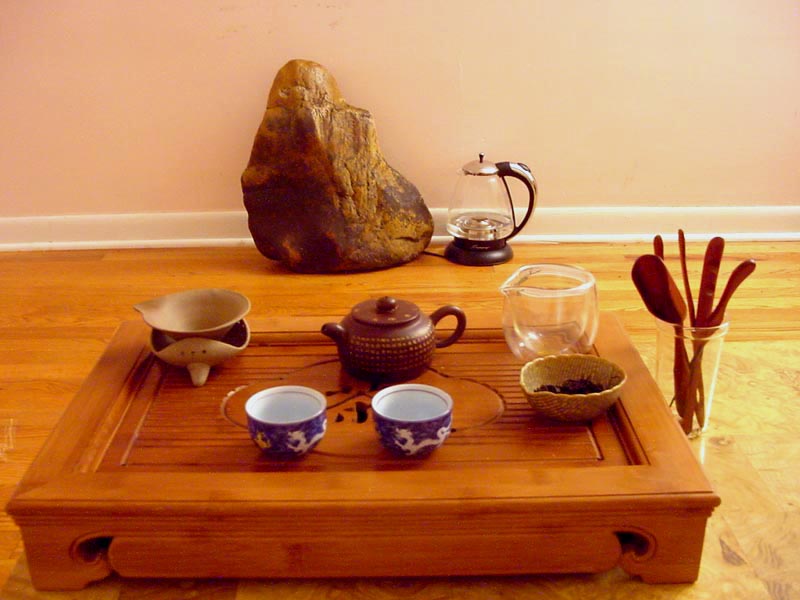
Cháozhōu Gōngfū Chá — The Original Tradition
Cháozhōu Gōngfū Chá (潮州工夫茶) — The Original Tradition
Cháozhōu gōngfū chá (潮州工夫茶) is the oldest and most formally codified style of gōngfū tea brewing, originating in the Cháozhōu (潮州) region of eastern Guǎngdōng province. While other regional styles exist, Cháozhōu is the reference — its utensils, ritual sequences, and cultural vocabulary define what gōngfū chá means at its most deliberate.
In 2022, "Chinese traditional tea crafts and related customs" were inscribed on the UNESCO Representative List of Intangible Cultural Heritage of Humanity. Cháozhōu gōngfū chá was specifically named among the defining practices within this inscription.
History
The term 工夫茶 (gōngfū chá) first appears in Cháozhōu local records from the Qing dynasty, specifically the Jiāqìng period (嘉庆, 1796–1820). The gazetteer Cháozhōu fǔzhì (潮州府志) records in the section on local customs: "在潮州,以工夫茶为贵" ("in Cháozhōu, gōngfū chá is held in high esteem"). The practice itself, however, formed earlier, with roots in the late Míng dynasty (17th century). At that time, merchants known as hǎishāng (海商, "sea traders") from Cháo'ān county (潮安) began carrying compact tea sets on their voyages.
From the mid-Qing through the early 20th century, the tradition remained distinctly regional, maintained by Cháoshān (潮汕) merchants and the Cháozhōu diaspora in Southeast Asia, who carried it through centuries of migration. During the Republican period (1912–1949), the practice was further refined and formalised. In the 1930s, tea masters from Shàntóu (汕头) and Cháozhōu began publishing the first instructional records, including the 17-step sequence that survives today. The tradition endured most strongly in Cháozhōu and Shàntóu, as well as among overseas communities in Thailand (where Cháozhōu people make up 40% of the Chinese diaspora), Malaysia, and Singapore — even through the 1960s and 1970s, when cultural practices were suppressed on the mainland.
The Four Treasures (四宝 Sìbǎo)
Cháozhōu brewing centres on four specific implements, known as the Four Treasures. These items were first described in the folk song Cháozhōu gōngfū chá sì bǎo gē (潮州工夫茶四宝歌), recorded in the 19th century.
1. 玉书煨 (Yùshū Wēi) — the Water Kettle
A flat, pear-shaped (梨形, líxíng) kettle made from red or white clay, used for boiling water over charcoal. Its distinctive shape distributes heat evenly and allows precise control of the flame. The lid fits loosely — it rises and falls with the boil, giving an audible and visual signal when the water is ready. Named after the master Yùshū (玉书), who, according to legend, first crafted this form in the 18th century. Original kettles were made from clay from Huánggǎng Mountain (黄岗山) in Cháo'ān county.
2. 潮汕炉 (Cháoshān Lú) — the Charcoal Stove
A small, compact red clay stove (made from red clay from the banks of the Hán River, 韩江畔红泥) designed specifically for the yùshū wēi kettle. Fuelled by charcoal — traditionally dense hardwood charcoal 榄炭 (lǎntàn, olive-pit charcoal) made from olive pits (橄榄核, gǎnlǎn hé). This charcoal is considered the premium choice for its clean, high heat (reaching about 800 °C) and faint fragrance, producing virtually no smoke. The charcoal fire is called 活火 (huó huǒ, "living fire") — contrasted with electric heat, which practitioners call "dead fire" (死火, sǐ huǒ), believed to lack the dynamic fluctuation that affects water quality.
3. 孟臣罐 (Měngchén Guàn) — the Teapot
A small zhūní (朱泥, red clay) or zǐshā (紫砂, purple clay) teapot, capacity 50–100 ml. Named after Huì Měngchén (惠孟臣), a master teapot craftsman of the late Míng and early Qīng dynasties (17th century) from Yíxīng county (宜兴). His pots became so prized that the name became synonymous with quality small teapots. Today the term refers to any well-made small pot in the traditional form, especially those made from Cháozhōu zhūní, which local masters call 潮州朱泥 (Cháozhōu zhūní).
Quality criterion — the Three Points in Line (三点一线, sān diǎn yī xiàn): When the pot is placed on a flat surface, the spout, mouth, and handle should align perfectly in one plane. This symmetry is a standard test for pot quality and indicates precision in forming.
Cháozhōu zhūní pots are distinct from Yíxīng zǐshā ware: the clay composition and firing temperatures differ — zhūní is fired at 1100–1180 °C, producing a smoother surface with an orange-red hue, while zǐshā is fired at 1150–1200 °C and is structurally more porous. See Yíxīng Zǐshā for comparison.
4. 若琛瓯 (Ruòchén Ōu) — the Cups
Tiny, thin-walled white porcelain cups, capacity 20–30 ml, named after the Qīng-dynasty master craftsman Ruòchén (若琛). 19th-century records mention that a master from Jǐngdézhèn (景德镇) made cups 4 cm in diameter and 2 cm high — these became canonical. Three cups are used, arranged in a 品 (pǐn) triangle — the character meaning "to taste," composed of three 口 (mouth) radicals. The small size and thin walls are deliberate: the cup warms quickly, cools quickly, and forces the drinker to sip attentively rather than drink casually.
The Tea: Fènghuáng Dāncōng
The tea of Cháozhōu gōngfū chá is Fènghuáng dāncōng (凤凰单丛) — single-bush oolongs from Fènghuáng Mountain (凤凰山, "Phoenix Mountain") in Cháozhōu county. The brewing method evolved alongside these teas: highly oxidised (oxidation level 50–70%), often heavily roasted at 140–160 °C, with concentrated aromatic profiles that reward multiple short infusions. The high leaf ratio extracts layers of character that would be overwhelmed in a Western-style long steep.
See Dāncōng Oolongs for detail on the tea itself.
The Ritual Sequence
Cháozhōu service is the most elaborate of the gōngfū traditions. The full formal sequence, known as the 17 steps of Cháozhōu gōngfū (潮州工夫茶十七步), was codified in the 1930s and incorporated into Cháozhōu's tea arts school curriculum in the 2010s:
| Step | Chinese | Notes |
|---|---|---|
| 茶具讲示 | Presenting utensils | Arranging and explaining each piece |
| 茶师净手 | Washing hands | Ritual cleansing of the practitioner |
| 泥炉生火 | Lighting the stove | Using 榄炭 (lǎntàn) charcoal |
| 砂铫掏水 | Filling the kettle | Fresh well or spring water only |
| 榄炭煮水 | Boiling with charcoal | Watching for "fish eyes" (90–95 °C) and "dragon's jets" (100 °C) |
| 开水热罐 | Warming the pot | Fill pot with boiling water; pour off |
| 再温茶盅 | Warming cups | Pour pot water over the three cups |
| 茗倾素纸 | Displaying the leaf | Show dry leaf on white paper |
| 壶纳乌龙 | Loading the pot | Fill to 60–70% capacity with leaf |
| 甘泉洗茶 | Rinsing the leaf | Flash steep (5–10 sec); discard |
| 提铋高冲 | High pour | Pour water from height of 20–30 cm to agitate leaf |
| 壶盖刮沫 | Scraping foam | Sweep lid across rim to clear surface foam |
| 淋盖追热 | Rinsing the lid | Pour water over exterior of pot — repeated on every steep to maintain temperature |
| 烫杯滚杯 | Rolling cups | Roll cups in boiling water to maintain temperature |
| 低洒茶汤 | Low pour | Pour from height of 3–5 cm into cups |
| 关公巡城 | Guān Gōng Patrols the City | Circular pouring sequence |
| 韩信点兵 | Hán Xìn Counts his Troops | Final drops distributed |
关公巡城 and 韩信点兵
These two steps are the most iconic of Cháozhōu tea service.
关公巡城 (Guān Gōng Xún Chéng): The practitioner pours from the pot in a continuous circular motion over all three cups simultaneously, moving back and forth in rotation. Named after Guān Yǔ (关羽), the Three Kingdoms general (220–280), whose constant vigilant patrols protected his army. The circular pour distributes the brew evenly so no cup receives a stronger or weaker infusion than another. The motion must be smooth and unbroken — this symbolises "unceasing care" (不断的关怀).
韩信点兵 (Hán Xìn Diǎn Bīng): When the pot is nearly empty, the final drops — the most concentrated — are distributed one by one to each cup. Named after Hán Xìn (韩信), the Hàn dynasty general (3rd century BCE) known for meticulous accounting of every soldier. The drops must be equalised; wasting even a drop is considered poor form — a sign of "unequal treatment of guests" (客不等).
The Tea Pond and Loofah — 茶洗 and 丝瓜络 (Chá Xǐ and Sīguā Luò)
In dry-style (干泡, gān pào) Cháozhōu brewing, the teapot is not sitting on a draining tray with water poured over it. Instead, a 茶洗 (chá xǐ) — a ceramic bowl filled with hot water — is used to keep the teapot warm between steeps. The pot sits in the bowl throughout the session. The same bowl is used to warm the cups before service.
Inside the 茶洗, a pad of 丝瓜络 (sīguā luò) — the dried fibrous skeleton of the loofah gourd (Luffa cylindrica, 丝瓜, sīguā) — is placed at the bottom. It cushions the zhūní pot from the hard ceramic bowl and keeps the pot slightly elevated so it sits in the water rather than resting directly on the base. The open fiber structure holds warm water against the exterior surface of the pot.
The 丝瓜络 is cut to fit the bowl — a rough round pad the diameter of the pot base. After each session it is rinsed clean and dried. It is biodegradable, costs almost nothing, and is replaced when the fibers compress or discolour permanently. This practice is unique to Cháozhōu: no other gōngfū tradition uses loofah pads.
In wet-style (湿泡, shī pào) brewing, the teapot sits on a tea tray (茶盘) and hot water is poured over the exterior throughout the session. The 茶洗 and loofah are not used.
Wet and Dry Table Styles
Cháozhōu practice distinguishes between two tray configurations:
Wet style (湿泡, shī pào): Hot water is poured liberally over the exterior of the teapot to maintain maximum temperature. The tray must drain continuously. This method ensures the pot stays hot through every steep — important in a cool room or for teas requiring sustained high temperature. The aesthetic is dynamic and water-forward. In Cháozhōu tea houses (茶楼), the wet style remains the default.
Dry style (干泡, gān pào): The table surface remains dry; excess water is managed carefully and the tray is decorative rather than functional. More common in modern practice for aesthetic reasons — easier to photograph, easier to manage in a domestic setting. The dry style gained popularity from the 2000s onward, as tea masters began blogging and filming videos.
Leaf Ratio and Infusions
Cháozhōu brewing uses an exceptionally high leaf ratio — approximately 1 g per 15 ml, filling the pot 60–70% with dry leaf. This is at the upper end even within gōngfū practice. The result is concentrated, aromatic, multi-dimensional brew that changes significantly across 8–12+ infusions.
Some Cháozhōu practitioners, particularly older traditionalists in the Cháoshān region (潮汕), push this further — filling the pot 80–100% with dry leaf, leaving almost no room for water. At this density the leaf cannot fully unfurl; the brew extracts in seconds and the first infusions are intensely concentrated. This extreme ratio is not a mistake or an affectation — it is a distinct approach to the tea that produces a different kind of depth, with later infusions lightening gradually over many rounds. Outsiders often find the first cup overwhelming; regulars pour smaller amounts and drink more slowly.
Water temperature: 95–100°C throughout. Dāncōng and roasted oolongs require full heat to extract their character.
Related
- Gōngfū Chá — Regional Traditions — overview of all regional styles
- Gōngfū Brewing Guide — step-by-step technique
- Dāncōng Oolongs — the tea of Cháozhōu
- Tea Pair Cups — Wénxiāng and Pǐnmíng — Táiwān-derived cup pair
- Yíxīng Zǐshā — related clay ware
- Yǎng Hú Bǐ — Yixing Tea Brush — related pot-conditioning tool
FAQ
Can I practice Cháozhōu gōngfū chá without all Four Treasures? Yes — the core of the practice is the high leaf ratio, short steeps, and the circular pouring sequence, not the specific utensils. A small Yíxīng or porcelain teapot (50–100 ml), tiny cups, and any heat source will produce authentic Cháozhōu-style brewing. The charcoal stove and clay kettle are traditional and add character, but modern practitioners widely use electric kettles. Start with what you have; acquire the traditional pieces as interest deepens.
How is Cháozhōu brewing different from what I see in tea shops or videos? Most tea shop demonstrations show the Táiwān-refined style of gōngfū chá (台湾功夫茶): a gàiwǎn, fairness pitcher (公道杯, gōngdào bēi), aroma cups (闻香杯, wénxiāng bēi), and individual tasting cups — a more elaborate and aesthetic setup that emerged in the 1970s. Cháozhōu is the older root: a small clay teapot, three shared cups in a triangle, no pitcher, and the circular pouring sequence directly from pot to cups. The Táiwān style is gentler and more visually theatrical; Cháozhōu is direct and concentrated, designed for regular use rather than ceremony. Another key difference: Cháozhōu tradition uses no cháhāi (pouring vessel) — the brew goes directly from pot to cup.
Does olive-pit charcoal (榄炭 lǎntàn) really make a difference? Practitioners argue it does: olive-pit charcoal burns hotter and cleaner than standard wood charcoal, with less smoke and a faint sweet fragrance. The high heat accelerates the boil without imparting unwanted aromas; the low smoke keeps the environment clean for sensitive aromatics. For most everyday brewing the difference is subtle — any clean charcoal works. Olive-pit charcoal matters most in formal demonstration settings and at competitions such as the Cháozhōu Gōngfū Chá Championship (潮州工夫茶大赛), where judges compare water quality across variables.
How do I season a new Měngchén zhūní teapot? Zhūní (朱泥) clay is denser and less porous than standard Yíxīng zǐshā and seasons more quickly. Basic seasoning: boil the new pot in plain water for 20–30 minutes to remove clay dust and kiln residue. Then brew a few sessions of your intended tea — traditionally dāncōng — discarding the first two or three sessions' tea or using it to rinse the exterior. Unlike standard zǐshā, zhūní does not require months of seasoning; it develops a subtle surface patina within weeks of regular use. Local masters in Cháozhōu say: "朱泥养三个月,紫砂养三年" ("zhūní is seasoned in three months, zǐshā in three years").
Must there be exactly three cups — can I use more or fewer? Three is traditional and meaningful (the 品 character, three mouths), but not mandatory in informal settings. In private brewing, cups adjust to the number of drinkers: one cup for solo, two cups for two people, four for four. The Guān Gōng circular pour simply extends its arc to cover however many cups are present. The three-cup 品 triangle is the ceremonial and formal default; adjust freely in informal contexts. 19th-century records mention that ordinary households often used four cups — one for each family member.
Comments (0)
No comments yet. Be the first!
Sign in — Sign in to join the discussion.